
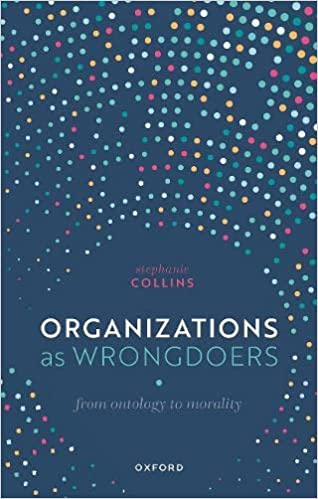
Organizations as Wrongdoers: From Ontology to Morality was published by Oxford University Press in 2023. You (or your library) can buy the book here. For institutional subscribers, it’s also on Oxford Scholarship Online. You can download the first chapter at the bottom of this page.
In July 2024, the book was the topic of a symposium at the Australasian Society for Legal Philosophy annual conference. The symposium was published in Journal of Legal Philosophy (behind a paywall, sorry!).
The book has three parts. Part I, ‘Metaphysics,’ considers how organizations have material existence that relates to organizations’ members. I push the surprising view that organizations are material objects with humans as material parts (like how a motorcycle is a material object with components as material parts). This makes organizations unmysterious as emergent objects in our social-political world. Organizational agents are not weird hovering ghosts; nor are they ‘just’ their members.
Part II, ‘Morality,’ explores how organizations can be blameworthy under three popular contemporary approaches to blameworthiness: the volitionist, attributivist, and aretaic approaches. Organizations can act intentionally, they can have evaluative attitudes, and they can have character traits (virtues and vices). I respond to a sentience-based objection to organizations’ blameworthiness, in the process of which I push the surprising view that organizations can literally feel guilt (when members feel guilt qua members).
Part III, ‘Members,’ turns to the implications of organizations’ wrongdoing for members. I catalogue the various ways members can be ‘implicated’ in organizational wrongdoing and provide guidance on how reparative burdens should be apportioned amongst members. Here, I push the totally unsurprising view that reparative burdens should be apportioned in accordance with members’ level of implication in the organization’s wrongdoing.
You can read the following reviews of the book:
Saba Bazargan-Forward in Mind.
Kenneth Silver in Ethics.
Katherine Ritchie in Analysis Reviews.
 Stephanie Collins